

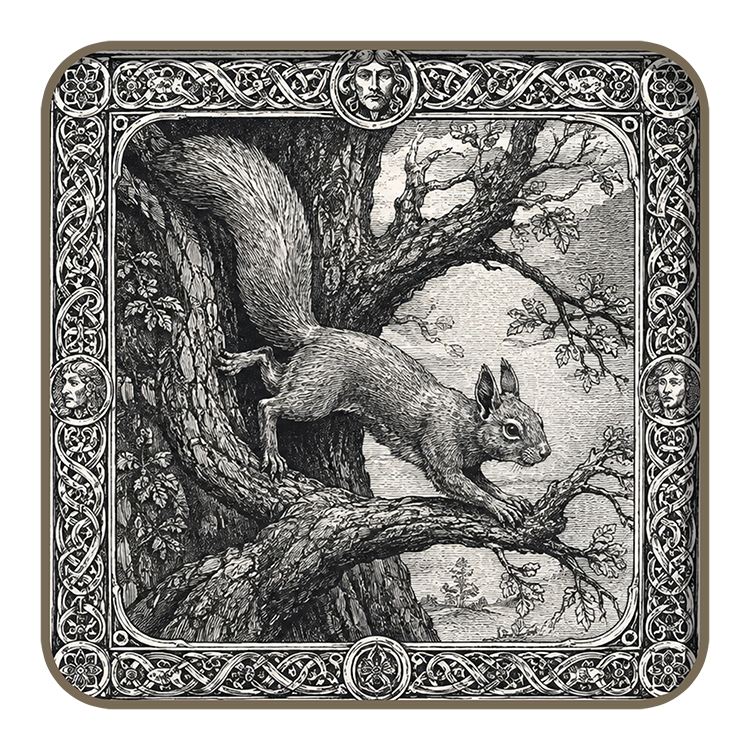
The clearest old description appears in the poem Grímnismál. Odin, speaking in disguise, explains that Ratatoskr runs along the ash tree and carries the words of the eagle down to Nidhöggr. Snorri Sturluson repeats the information in the Prose Edda and says the squirrel bears malicious messages between them. These two short passages provide most of what the medieval sources tell us. At Yggdrasil’s top sits a great eagle. A hawk called Vedrfölnir perches between its eyes. At the roots, Nidhöggr gnaws at the tree. Four stags browse among the branches, while other serpents live beneath. Ratatoskr travels between these different levels. He is tiny beside the eagle and dragon, but his route crosses an entire universe. The myths do not explain how the argument began or quote the insults.
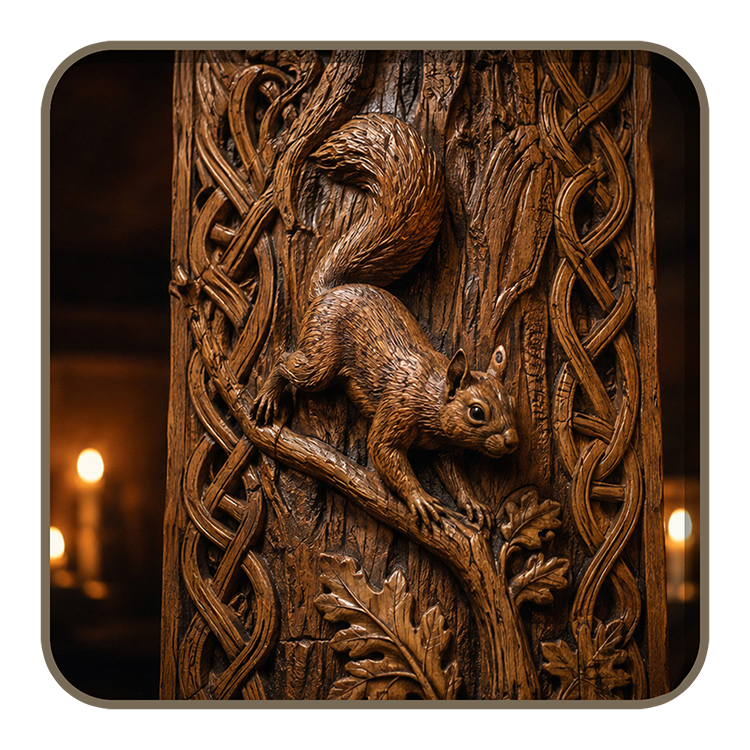
That gap has encouraged modern writers to invent conversations, secret missions and comical personalities. Such additions can be fun as long as readers know they are new. In the Eddas, Ratatoskr is defined by movement and message-carrying, not by a long personal adventure. His name is often translated as “drill-tooth” or “boring tooth”. Scholars discuss its exact formation, but it suits a squirrel’s sharp teeth and habit of gnawing. Real red squirrels scramble rapidly up trunks, hide food and make sharp calls. Someone watching them in Scandinavian woodland could easily imagine one carrying news between the top and bottom of a tree. Why would a cosmic tree contain conflict? Yggdrasil supports worlds, gods, humans, giants and the dead, but it is not a peaceful decoration.
Creatures eat its leaves and roots, decay threatens it, and the Norns pour water and clay over it. Ratatoskr’s insults add social damage to physical damage. The tree survives through constant care rather than remaining perfect and untouched. Ratatoskr is sometimes called a trickster like Loki. There is a resemblance because both can stir up trouble with words. However, the sources never call Ratatoskr a god, give him Loki’s shape-changing powers or make him responsible for Ragnarok. He is a mythological animal with a specific job. It is better to enjoy that role than to enlarge it into claims the poems do not support.




Hi! I’m Jocelyn, and I created Mythfits Society to make discovering ancient myths easier, more interesting and much more fun.
Read My Story