

Before Narmer, communities along the Nile had already grown into powerful regional centres. Upper Egypt lay in the south, while Lower Egypt covered the Nile Delta in the north. Trade, alliances, competition and warfare connected them. Earlier rulers had expanded their influence, so Narmer did not create a kingdom from nothing. He may have completed or advertised a long process of unification. Later king lists begin with Menes, and scholars debate whether Menes was Narmer, his successor Hor-Aha or a traditional name. The most famous evidence is the Narmer Palette, discovered at Hierakonpolis and displayed in the Egyptian Museum in Cairo. It is a large ceremonial stone object shaped like palettes once used for grinding cosmetics. One side shows Narmer wearing the tall white crown of Upper Egypt as he strikes a kneeling enemy.
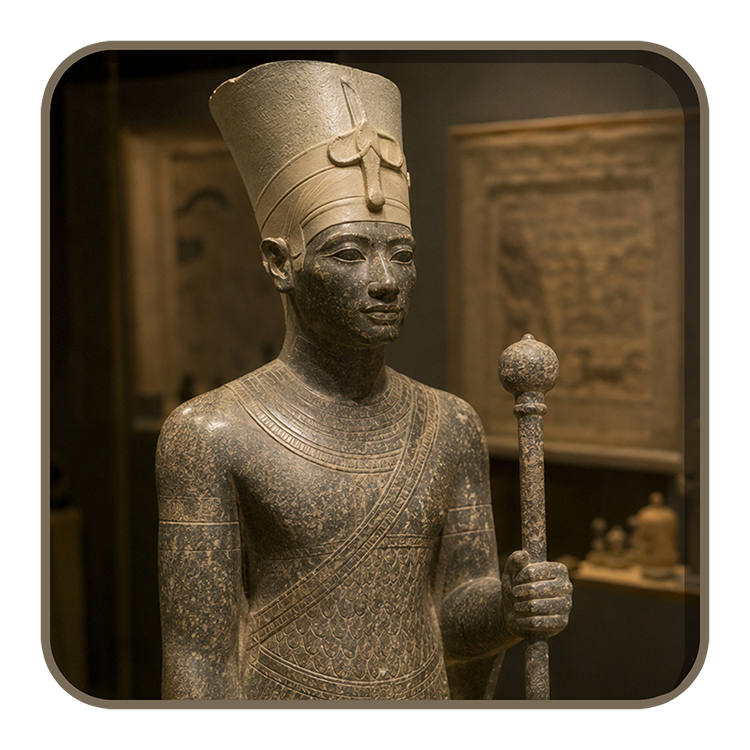
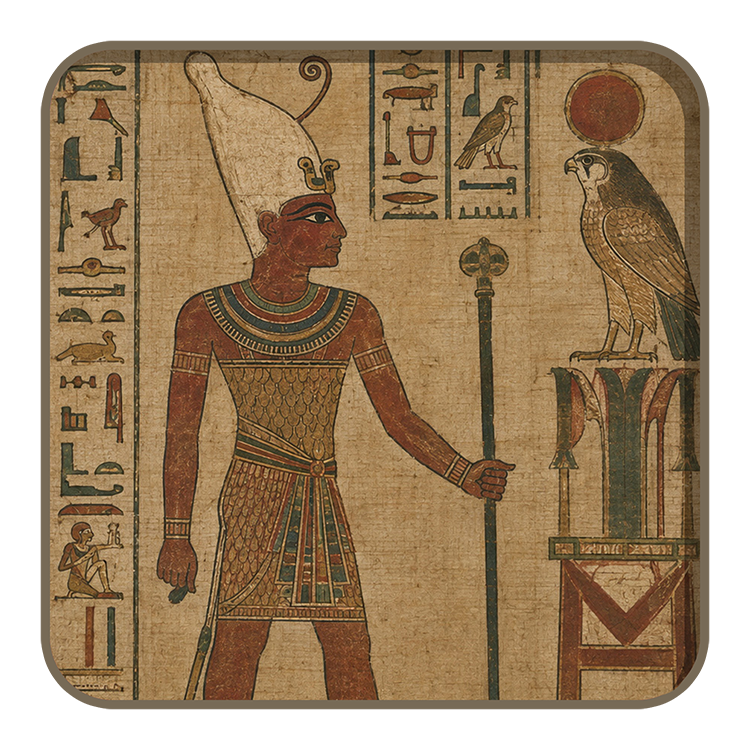
The other shows him wearing the red crown linked with Lower Egypt. These two crowns support the idea that he claimed authority over both lands. The palette is not a photograph of an event. Narmer is much larger than other people because size represents importance. A falcon, linked with Horus and kingship, stands above papyrus plants and a captive. Rows of defeated bodies present victory in a carefully ordered way. Two long-necked mythical animals twist together around the central circle. At the bottom, a bull breaks into a fortified place. Every section communicates royal power, control over enemies and the creation of order. Narmer's name appears inside a rectangular palace sign called a serekh, topped by the falcon Horus. The signs used for his name are a catfish and a chisel.
Objects bearing his name have been found beyond the Nile Valley, showing that exchange networks connected Egypt with southern Canaan. Archaeologists must decide whether such objects arrived through trade, official expeditions, migration or political control. A royal name found far away does not automatically prove conquest. Royal tombs of this period were built at Abydos. Tomb B17-B18 is generally linked with Narmer, although little treasure survived. Its mud-brick chambers seem modest beside later pyramids, but early kings were establishing rituals that developed for centuries. Labels and seal impressions recorded goods, places and royal activities. Writing was still limited and often worked beside images.




Hi! I’m Jocelyn, and I created Mythfits Society to make discovering ancient myths easier, more interesting and much more fun.
Read My Story